Image Type
Torg/Pavlov Canal-to-Body Ratio
1) Description of Measurement
The Torg/Pavlov Canal-to-Body Ratio is a radiographic metric used to evaluate cervical spinal canal stenosis on a lateral cervical spine X-ray.
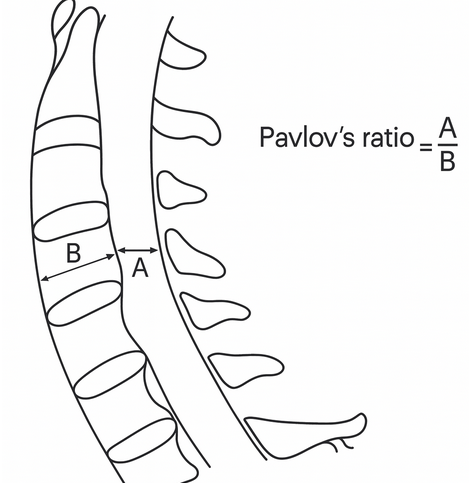
It represents the ratio between the sagittal diameter of the spinal canal and the sagittal diameter of the corresponding vertebral body at the same level.
This ratio helps account for radiographic magnification errors and provides a reliable screening tool for detecting congenital or acquired cervical stenosis, which predisposes patients to myelopathy or spinal cord injury even after minor trauma.
2) Instructions to Measure
Obtain a neutral lateral cervical spine X-ray (as shown in the provided images).
Identify the vertebral level to be assessed (typically C3–C7).
For each level:
Measure the sagittal canal diameter (A): the shortest distance between the posterior surface of the vertebral body and the nearest point on the spinolaminar line (posterior vertebral canal wall).
Measure the sagittal vertebral body diameter (B): the anteroposterior width of the vertebral body from the anterior to posterior cortex.
Calculate the Torg/Pavlov Ratio:
Canal-to-Body Ratio (Torg/Pavlov Ratio) = ABRepeat at multiple levels (C3–C7) and record the lowest ratio, as this represents the narrowest point.
Ensure proper lateral centering — parallax or rotation can lead to inaccurate canal or body measurements.
3) Normal vs. Pathologic Ranges
Normal: ≥ 0.8; adequate canal dimensions
Borderline: 0.7-0.8; mild relative stenosis
Pathologic: ≤ 0.7; congenital or acquired cervical stenosis (high risk for myelopathy)
Severe: ≤ 0.6; strongly predictive of cervical myelopathy and cord injury risk
4) Important References
Pavlov H, Torg JS, Robie B, Jahre C. Cervical spinal stenosis: determination with vertebral body ratio method. Radiology. 1987;164(3):771–775.
Torg JS, Pavlov H, Genuario SE, et al. Neck injuries to athletes: a prospective study of the cervical spinal canal. J Bone Joint Surg Am. 1986;68(9):1354–1363.
Boden SD, McCowin PR, Davis DO, Dina TS, Mark AS, Wiesel SW. Abnormal magnetic-resonance scans of the cervical spine in asymptomatic subjects. J Bone Joint Surg Am. 1990;72(8):1178–1184.
Morishita Y, Naito M, Hymanson HJ, Miyazaki M, Wu G, Wang JC. The relationship between the Torg–Pavlov ratio and spinal cord area in the cervical spine: a study using MRI. Spine. 2009;34(5):E197–E202.
5) Other info....
The Torg/Pavlov Ratio eliminates magnification error, making it reliable across different radiographic setups.
It is a screening measurement; confirmatory evaluation with MRI or CT should be performed if the ratio is ≤ 0.7 or symptoms suggest cord compression.
A Torg/Pavlov ratio ≤ 0.7 correlates closely with reduced space for the cord and a higher risk of neurological injury during hyperextension trauma.
Congenital stenosis (low ratio across multiple levels) is distinguished from acquired stenosis (focal narrowing due to osteophytes, disc protrusion, or ligamentous hypertrophy).
The C5–C6 level typically has the smallest canal and is the most clinically significant region for evaluating stenosis.
Dynamic flexion-extension films may further demonstrate functional narrowing of the canal.