
Image Type
Power’s Ratio
1) Description of Measurement
Power’s ratio is a geometric index designed to identify anterior atlanto-occipital dislocation. It evaluates relative motion between the skull base and the atlas.
2) Instructions to Measure
Choose a mid-sagittal CT.
Landmark A (Basion): The anterior margin of the foramen magnum.
Landmark C (Opisthion): The posterior margin of the foramen magnum.
Landmark D: The posterior surface of the anterior tubercle of C1.
Landmark B: The anterior surface of the posterior arch of C1.
Calculation: Measure the length of line AB and line CD. Divide AB by CD.
3) Normal vs. Pathologic Ranges
Plain Radiographs: < 1.0 (The length of AB should be less than CD).
CT Scans: < 0.9. The superior resolution of CT dictates a stricter threshold.
Pathologic: A ratio > 1.0 is diagnostic of Anterior Atlanto-Occipital Dislocation.
4) Important References
Powers B, Miller MD, Kramer RS, Martinez S, Gehweiler Jr JA. Traumatic anterior atlanto-occipital dislocation. Neurosurgery. 1979 Jan 1;4(1):12-7.
Bono CM, Vaccaro AR, Fehlings M, et al. Measurement techniques for upper cervical spine injuries: consensus statement of the spine trauma study group. Spine. 2007;32:593-600.
Rojas CA, Bertozzi JC, Martinez CR, Whitlow J. Reassessment of the craniocervical junction: normal values on CT. AJNR Am J Neuroradiol. 2007;28(9):1819-1823. doi:10.3174/ajnr.A0660
Kasliwal MK, Fontes RB, Traynelis VC. Occipitocervical dissociation-incidence, evaluation, and treatment. Curr Rev Musculoskelet Med. 2016;9(3):247-254. doi:10.1007/s12178-016-9347-6
5) Other info....
A normal Powers Ratio doesn't exclude AOD, as it's specific for anterior dislocation but a poor screening for general craniocervical instability.
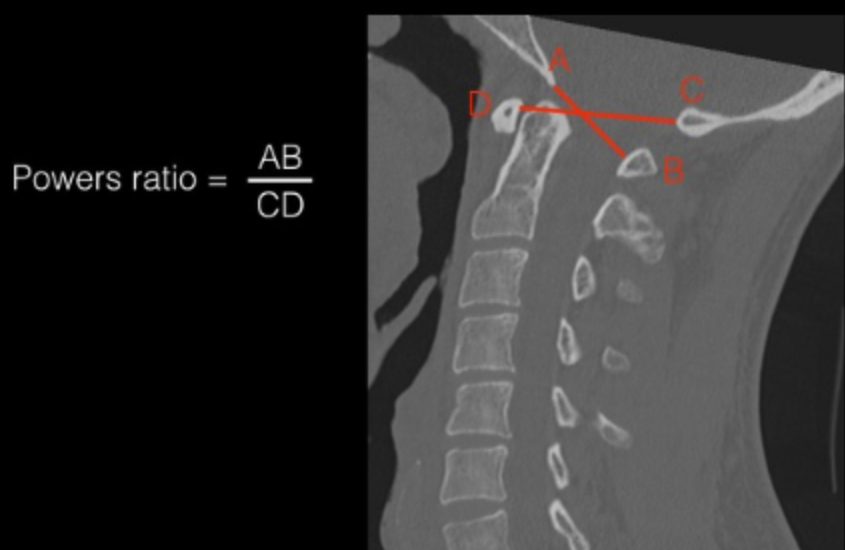
Adapted from: Knipe H, Atlantodental interval. Radiopaedia.org (Accessed on 17 Dec 2025). https://doi.org/10.53347/rID-38418