Image Type
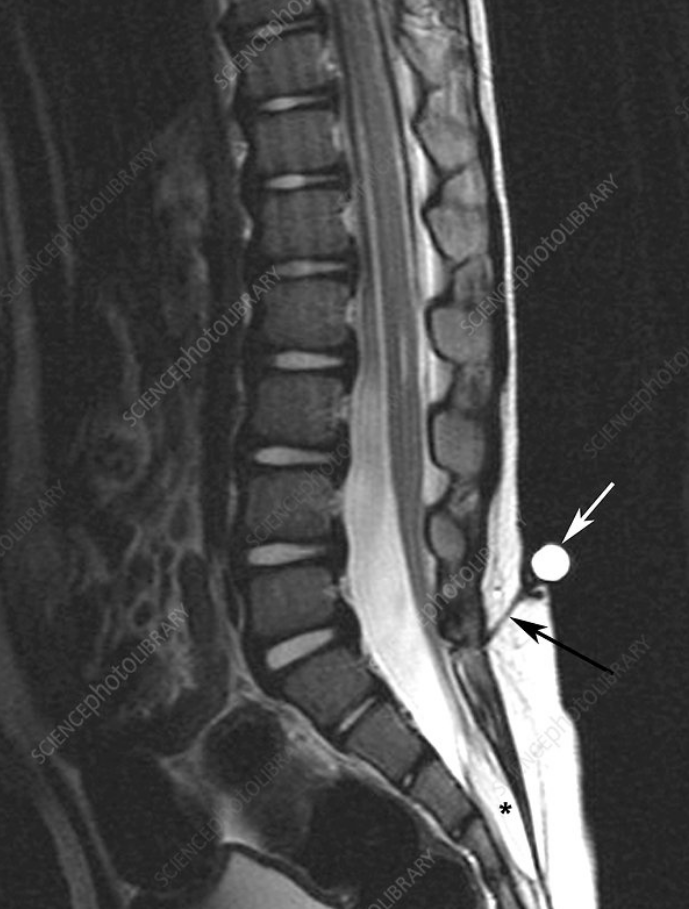
Lipoma or Dermal Sinus Tract
1) Description of Measurement
Spinal lipomas and dermal sinus tracts are distinct forms of occult spinal dysraphism with different embryologic origins, risks, and surgical implications. A spinal lipoma is a benign lesion composed of mature adipose tissue that may infiltrate or attach to neural elements, often causing cord tethering or mass effect. In contrast, a dermal sinus tract is an epithelium-lined channel extending from the skin surface into deeper spinal structures, formed by incomplete separation of cutaneous and neural ectoderm. Unlike lipomas, dermal sinus tracts pose a direct infectious risk due to communication between the skin and the spinal canal.
2) Instructions to Measure
Perform MRI of the entire spine, with sagittal and axial T1- and T2-weighted sequences. Use T1-weighted MRI to identify hyperintense fat-containing lesions.
For suspected lipoma:
Identify intradural or intramedullary fat signal
Assess relationship to the conus, filum terminale, and nerve roots
Evaluate for cord tethering
For suspected dermal sinus tract:
Trace any tract from the skin surface to deeper tissues
Determine whether it enters the spinal canal
Look for associated intradural lesions (dermoid or epidermoid cysts)
Use contrast-enhanced MRI if infection or abscess is suspected.
CT may help evaluate associated bony dysraphism.
3) Normal vs. Pathologic Ranges
Normal: No midline tracts or intradural fat
Pathologic
Lipoma: any fat-containing lesion within the spinal canal, particularly if associated with low conus or thickened filum
Dermal sinus tract: any persistent epithelial tract extending beyond subcutaneous tissues, especially if intradural
Dermoid or epidermoid tumors are present in up to 60% of dermal sinus tract cases.
4) Important References
Ackerman LL, Menezes AH. Spinal congenital dermal sinuses: a 30-year experience. Pediatrics. 2003 Sep;112(3 Pt 1):641-7. doi: 10.1542/peds.112.3.641. PMID: 12949296.
Tisdall MM, Hayward RD, Thompson DN. Congenital spinal dermal tract: how accurate is clinical and radiological evaluation? J Neurosurg Pediatr. 2015 Jun;15(6):651-6. doi: 10.3171/2014.11.PEDS14341. Epub 2015 Mar 13. PMID: 26030333.
5) Other info....
Dermal sinus tracts must be treated as potentially infected lesions, even when asymptomatic, due to the risk of meningitis, intramedullary abscess, or dermoid rupture.