Image Type
George’s Line (Posterior Vertebral Body Line)
1) Description of Measurement
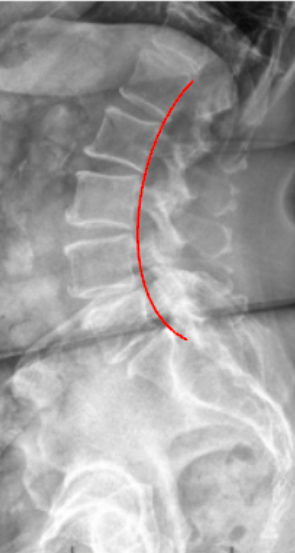
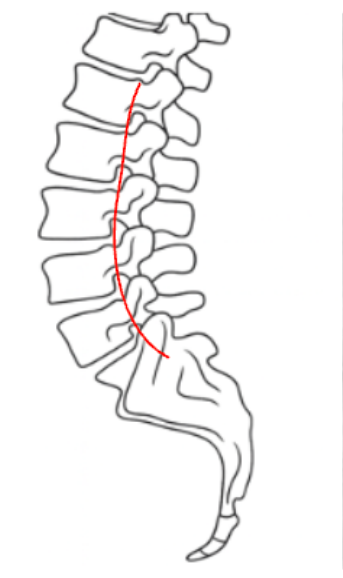
George’s Line—also known as the Posterior Vertebral Body Line—is a sagittal alignment assessment used to evaluate vertebral body translation and spinal stability.
It is drawn along the posterior margins of each lumbar vertebral body on a lateral X-ray and should form a continuous, smooth curve from L1 through the sacrum.
Any disruption or step-off between adjacent vertebrae suggests anterior or posterior displacement—commonly associated with spondylolisthesis, fracture, or ligamentous injury.
2) Instructions to Measure
Obtain a standing lateral lumbar spine X-ray in neutral posture.
Identify the posterior margins of each lumbar vertebral body from L1 through S1.
Using a straight edge or digital PACS line tool, draw a smooth curve following the posterior vertebral borders.
Assess the line for continuity:
A smooth curve indicates normal alignment.
A step-off or break indicates vertebral translation.
If discontinuity is noted, quantify displacement by measuring the horizontal distance (in mm) between posterior body margins of adjacent vertebrae at the point of offset.
Repeat on flexion/extension radiographs to assess for dynamic instability if clinically indicated.
3) Normal vs. Pathologic Ranges
Normal line: continuous, smooth curve; preserved posterior alignment
Mild malalignment: step-off ≤ 2 mm; possible early degenerative or positional change
Abnormal: step-off > 2 mm; suggests subluxation or ligamentous injury
Pathologic: step-off > 3.5 mm; diagnostic for lumbar instability
4) Important References
White AA, Panjabi MM. Clinical Biomechanics of the Spine. 2nd ed. Philadelphia: Lippincott; 1990.
Lee C, Woodring JH, Rogers LF, Kim KS. Sagittal alignment of the lumbar spine: significance of the posterior vertebral line. AJR Am J Roentgenol. 1986;146(3):707-714.
Harris JH Jr, Edeiken-Monroe B. The Radiology of Emergency Medicine. 3rd ed. Baltimore: Williams & Wilkins; 1993.
Swartz EE, Floyd RT, Cendoma M. Cervical and lumbar spine functional anatomy and the biomechanics of injury due to compressive loading. J Athl Train. 2005;40(3):155–161.
5) Other info....
George’s Line is part of the three-line lumbar assessment, alongside the anterior vertebral line and spinolaminar line, providing a quick screen for sagittal integrity.
Step-offs correspond to vertebral translation seen in degenerative spondylolisthesis, traumatic subluxation, or pars defects.
Best assessed on true lateral radiographs with neutral pelvis and minimal rotation.
CT or MRI should follow if misalignment is present to evaluate facet integrity and neural compression.
Dynamic instability is defined by > 3.5 mm translation or > 11° angular motion between flexion and extension views.