Image Type
Ferguson’s Line
1) Description of Measurement
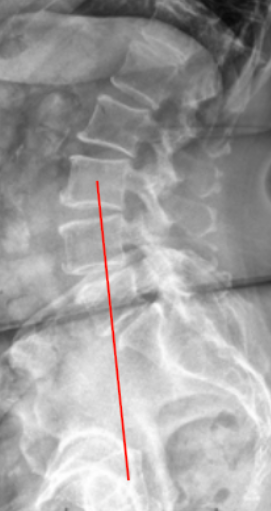
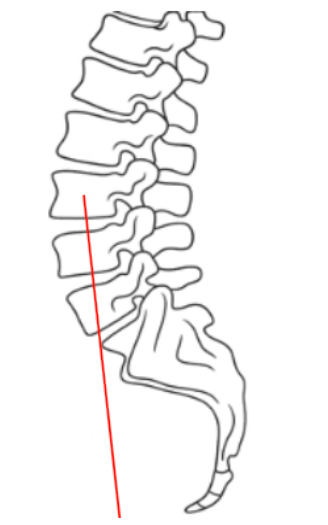
Ferguson’s Line, also known as the Weight-bearing Line of the Lumbar Spine, is a radiographic alignment reference used to evaluate sagittal load distribution through the lumbar spine and pelvis during standing posture.
This measurement assesses whether the axial load of the upper body is being transmitted appropriately through the lumbosacral junction. It is particularly useful in identifying anterior or posterior sagittal imbalance, instability, or pathologic stress on the sacrum.
When drawn correctly, Ferguson’s Line passes vertically from the center of the L3 vertebral body down through the sacrum. Its relative position on the sacral base indicates whether spinal loading is balanced (normal) or shifted (pathologic).
2) Instructions to Measure
Obtain a standing lateral lumbar X-ray that includes at least T12 through the sacrum in a neutral posture (no flexion/extension).
Identify the midpoint of the L3 vertebral body.
This is the intersection of lines bisecting L3’s anterior and posterior borders and its superior and inferior endplates.
From this midpoint, draw a vertical line perpendicular to the horizontal reference (ground level).
This represents Ferguson’s Line or the weight-bearing line.
Extend the line downward to intersect the sacrum and pelvis.
Observe and record where the line passes through the sacral base:
Normal: near the anterior third of the sacral base.
Pathologic: anterior or posterior deviation relative to this zone.
Compare with the patient’s posture and correlate with other sagittal parameters (Sacral Slope, Pelvic Tilt, and SVA).
3) Normal vs. Pathologic Ranges
Normal alignment: line passes through anterior third of sacral base; balanced sagittal load distribution
Posterior imbalance: line passes through posterior to the anterior third (toward mid-sacrum); load shift posteriorly, may indicate flat-back posture or compensatory pelvic retroversion
Anterior imbalance: line passes anterior to sacral base; excessive anterior load, associated with hyperlordosis or spondylolisthesis
Marked posterior imbalance: line passes posterior to sacrum entirely; global sagittal malalignment, often symptomatic
Key Point:
In a physiologic posture, the vertical load from L3 should fall through the anterior third of the sacral base to maintain efficient energy transfer and lumbosacral stability.
4) Important References
Ferguson AB. The weight-bearing line in relation to lumbar disc conditions. J Bone Joint Surg. 1931;13(4):875–890.
Roussouly P, Gollogly S, Berthonnaud E, Dimnet J. Classification of the normal variation in the sagittal alignment of the human lumbar spine and pelvis. Spine. 2005;30(3):346–353.
Vialle R, Levassor N, Rillardon L, Templier A, Skalli W, Guigui P. Radiographic analysis of the sagittal alignment and balance of the spine in asymptomatic subjects. J Bone Joint Surg Am. 2005;87(2):260–267.
Le Huec JC, Aunoble S, Philippe L, Nicolas P. Pelvic parameters: origin and significance. Eur Spine J. 2011;20(Suppl 5):564–571.
Schwab FJ, Lafage V, Patel A, Farcy JP. Sagittal plane considerations and the pelvis in the adult patient. Spine. 2009;34(17):1828–1833.
5) Other info....
Ferguson’s Line provides a simple visual estimation of sagittal balance and weight transmission through the spine in the standing position.
It serves as an early radiographic method to assess functional alignment before modern parameters (SVA, PI–LL, PT, etc.) were developed, and it remains conceptually useful.
Anterior deviation indicates hyperlordotic patterns or forward sagittal shift; posterior deviation correlates with flat-back or posterior pelvic rotation.
The measurement should be performed on standing images only—supine X-rays misrepresent load alignment.
Clinically, it helps correlate imaging with postural fatigue, low-back pain, or sagittal imbalance.
For comprehensive evaluation, it should be analyzed in conjunction with:
Sacral Slope (SS) – determines sacral orientation.
Pelvic Tilt (PT) – quantifies pelvic compensation.
Sagittal Vertical Axis (SVA) – assesses global sagittal balance.
Modern use: Ferguson’s Line still appears in educational and historical contexts as a conceptual tool linking classic radiography with modern sagittal analysis.