Image Type
SRS–Schwab Classification (2012)
1) Description of Measurement
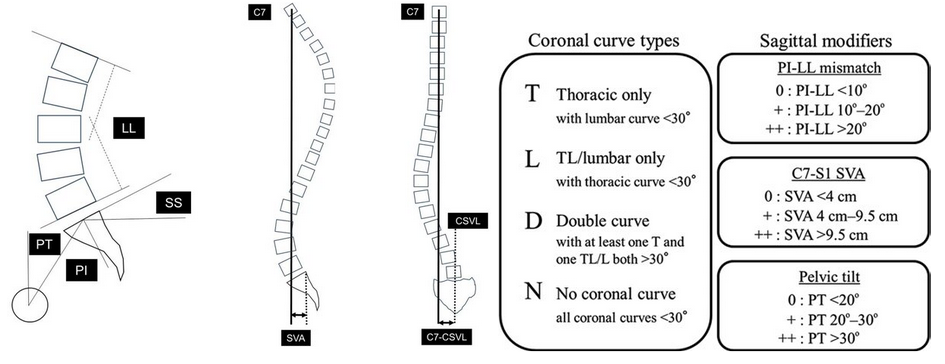
The SRS–Schwab ASD Classification (2012) classifies adult spinal deformity (ASD) based on radiographic parameters linked to pain, disability, and HRQOL. It improves earlier systems by including sagittal alignment and the spine-pelvis interaction. The system has two components.
Coronal curve type describes the location and magnitude of scoliosis, and
Sagittal modifiers quantify global balance and pelvic compensation using PI–LL mismatch, sagittal vertical axis (SVA), and pelvic tilt (PT). These modifiers capture both the severity of the deformity and the compensatory mechanisms patients use to remain upright.
2) Instructions to Measure
Imaging requirements: standing full-length AP and lateral radiographs, including C7 and both femoral heads.
A) Coronal curve type (PA radiograph)
Measure Cobb angles of thoracic and lumbar curves.
Only curves >30° are considered.
T (thoracic major): thoracic curve >30°, apex at T9 or cranial
L (lumbar major): thoracolumbar/lumbar curve >30°, apex at T10 or caudal
D (double major): both thoracic and lumbar curves >30°
N (normal): no coronal curve >30°
B) Sagittal modifiers (lateral radiograph)
Pelvic Incidence (PI)
Angle between a line perpendicular to the S1 endplate at its midpoint and a line connecting that point to the femoral head axis.
Fixed morphologic parameter.
Lumbar Lordosis (LL)
Cobb angle from L1 superior endplate to S1 superior endplate.
PI–LL mismatch
Calculated as PI minus LL; reflects harmony between pelvic morphology and lumbar curvature.
SVA
Horizontal distance between the C7 plumb line and the posterosuperior corner of S1.
PT
Angle between the vertical and the line connecting the midpoint of the S1 endplate to the femoral head axis.
Reflects pelvic retroversion, a key compensatory mechanism.
3) Normal vs. Pathologic Ranges
Each sagittal modifier is graded by severity.
PI–LL mismatch
0: <10°
+ (1): 10–20°
++ (2): >20°
SVA
0: <40 mm
+ (1): 40–95 mm
++ (2): >95 mm
PT
0: <20°
+ (1): 20–30°
++ (2): >30°
Thresholds associated with severe disability (ODI >40) include:
PT >22°
PI–LL >11°
SVA >46 mm
4) Important References
Terran J, Schwab F, Shaffrey CI, Smith JS, Devos P, Ames CP, Fu KM, Burton D, Hostin R, Klineberg E, Gupta M, Deviren V, Mundis G, Hart R, Bess S, Lafage V; International Spine Study Group. The SRS-Schwab adult spinal deformity classification: assessment and clinical correlations based on a prospective operative and nonoperative cohort. Neurosurgery. 2013 Oct;73(4):559-68. doi: 10.1227/NEU.0000000000000012. PMID: 23756751.
Lowe T, Berven SH, Schwab FJ, Bridwell KH. The SRS classification for adult spinal deformity: building on the King/Moe and Lenke classification systems. Spine (Phila Pa 1976). 2006 Sep 1;31(19 Suppl):S119-25. doi: 10.1097/01.brs.0000232709.48446.be. PMID: 16946628.
Bess S, Schwab F, Lafage V, Shaffrey CI, Ames CP. Classifications for adult spinal deformity and use of the Scoliosis Research Society-Schwab Adult Spinal Deformity Classification. Neurosurg Clin N Am. 2013 Apr;24(2):185-93. doi: 10.1016/j.nec.2012.12.008. PMID: 23561557.
Diebo BG, Varghese JJ, Lafage R, Schwab FJ, Lafage V. Sagittal alignment of the spine: What do you need to know? Clin Neurol Neurosurg. 2015 Dec;139:295-301. doi: 10.1016/j.clineuro.2015.10.024. Epub 2015 Oct 28. PMID: 26562194.
5) Other info....
Age-adjusted modifications (Lafage et al. 2022) have been proposed to account for age-related changes in alignment targets.