
Image Type
Traction Films / Push-prone Films
1) Description of Measurement
Traction and push-prone (fulcrum bending) films assess passive coronal plane flexibility of scoliotic curves by measuring the residual Cobb angle under externally applied corrective forces.
Unlike active side-bending films, these techniques minimize patient effort and better reflect the true mechanical stiffness of the curve, making them particularly useful for operative planning, implant selection, and prediction of postoperative correction.
2) Instructions to Measure
Position the patient laterally over a padded fulcrum placed beneath the apex of the curve.
Acquire a full-length AP radiograph while the torso is allowed to drape freely over the fulcrum.
Measure the residual Cobb angle using the same end vertebrae as on the erect film.
Flexibility = (Erect Cobb - Traction / Push-Prone Cobb)/Erect Cobb* 100
3) Normal vs. Pathologic Ranges
Highly flexible curve: > 60%
Moderately flexible curve: 40 - 60%
Rigid/structural curve: < 40%
Stiff deformity: minimal / no change
Key points:
Rigid curves typically require more extensive osteotomies or longer fusion constructs.
High flexibility predicts greater postoperative correction.
4) Important References
Pluemvitayaporn T, Jackkaew W, Surapuchong S, et al. A comparative study of curve flexibility assessment in supine traction, push-prone and push-prone traction radiographs in adolescent idiopathic scoliosis. Spine Deform. 2025 May;13(3):753-763. doi: 10.1007/s43390-025-01051-w.
Cheung WY, Lenke LG, Luk KD. Prediction of scoliosis correction with thoracic segmental pedicle screw constructs using fulcrum bending radiographs. Spine (Phila Pa 1976). 2010 Mar 1;35(5):557-61. doi: 10.1097/BRS.0b013e3181b9cfa9.
Liu RW, Teng AL, Armstrong DG, et al. Comparison of supine bending, push-prone, and traction under general anesthesia radiographs in predicting curve flexibility and postoperative correction in adolescent idiopathic scoliosis. Spine (Phila Pa 1976). 2010 Feb 15;35(4):416-22. doi: 10.1097/BRS.0b013e3181b3564a.
5) Other info....
Traction and push-prone films are particularly useful in:
Severe curves (>70°)
Patients unable to actively bend
Preoperative evaluation of stiff thoracic deformities
Should be interpreted in conjunction with:
Standing AP Cobb angles
Side-bending films
Sagittal profile
Residual Cobb angle on traction/fulcrum films often provides the best estimate of achievable surgical correction and guides:
Selection of fusion levels
Decision for posterior-only vs combined anterior-posterior approaches
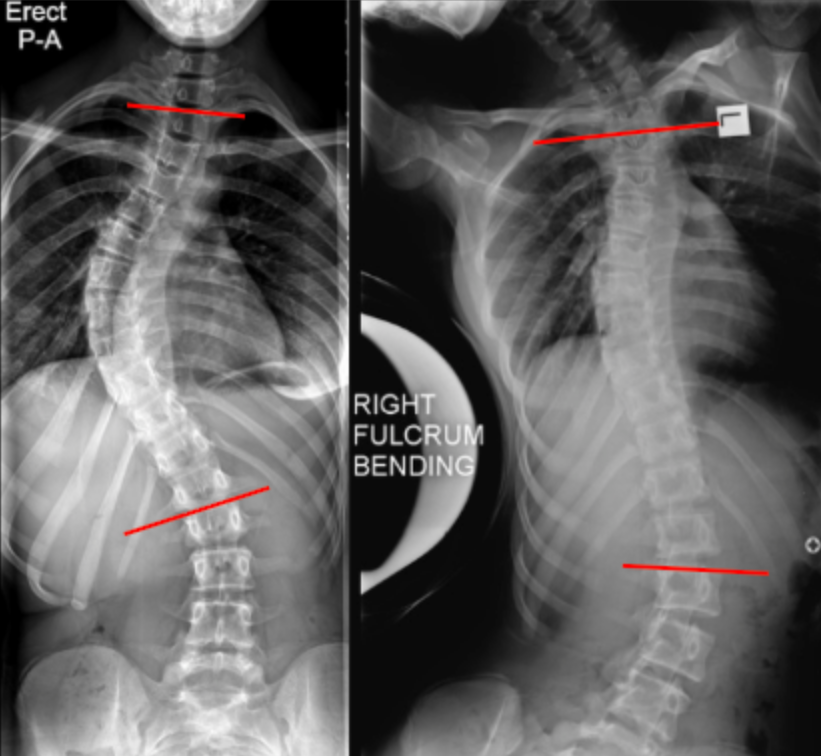
Adapted from: Gaillard F, Scoliosis. Case study, Radiopaedia.org (Accessed on 28 Dec 2025) https://doi.org/10.53347/rID-49513