
Image Type
High-intensity Zone (HIZ)
1) Description of Measurement
The conus medullaris level refers to the vertebral level at which the spinal cord tapers to form the conus before continuing as the cauda equina. Determining this level is essential for identifying tethered cord syndrome, congenital anomalies, tumors, trauma, or postsurgical complications.
2) Instructions to Measure
Identify the spinal cord tapering point where the cord transitions into the cauda equina — this is the conus medullaris tip.
Count vertebral bodies caudally from T12 to accurately identify the corresponding level.
Assign the conus termination to the nearest vertebral body or intervertebral disc level (e.g., upper L1, L1–L2 disc, mid-L2).
Record the level as a specific anatomic location, not just a vertebral number (e.g., “upper L1 body”).
3) Normal vs. Pathologic Ranges
Normal range: T12-L2
Low-lying/possible tethered cord: Below L2 vertebral body
High-riding conus: Above T12 (rare, congenital or post-traumatic)
Key point:
Most adults have conus termination at the L1–L2 disc level or upper L2 body.
4) Important References
Grimme JD, Castillo M. Congenital anomalies of the spine. Neuroimaging Clin N Am. 2007 Feb;17(1):1-16. doi: 10.1016/j.nic.2006.11.002.
Costa Almeida L, de Souza Figueiredo YJ, Pinheiro Zylberman A, Garção DC. Ascent of the conus medullaris in human foetuses: a systematic review and meta-analysis. Sci Rep. 2022 Jul 25;12(1):12659. doi: 10.1038/s41598-022-15130-9.
Yamada S, Won DJ, Siddiqi J, Yamada SM. Tethered cord syndrome: overview of diagnosis and treatment. Neurol Res. 2004 Oct;26(7):719-21. doi: 10.1179/016164104225017947.
5) Other info....
A conus terminating below the L2 body should prompt evaluation for:
Thickened filum terminale
Intradural lipoma
Dermal sinus or other dysraphic anomalies
Conus level should always be interpreted with:
Filum thickness
Neurologic symptoms
Associated spinal anomalies
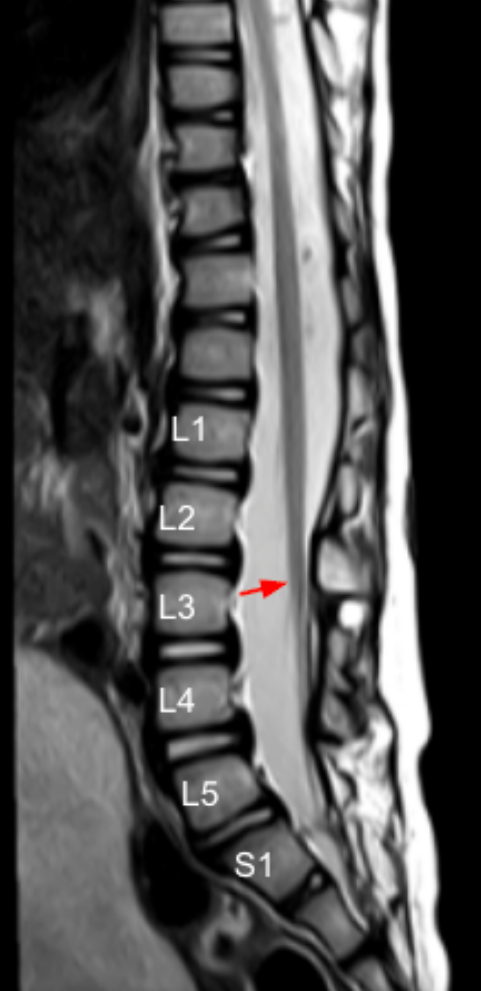
Adapted from: Jones J, Sharma R, Gaillard F, et al. Conus medullaris. Reference article, Radiopaedia.org (Accessed on 03 Jan 2026) https://doi.org/10.53347/rID-10569